The real cost of manual call auditing (and what it misses)
Manual QA reviews a small sample of calls and misses the rest. See the direct, opportunity and risk costs of sampling, and what full AI auditing changes.
The hidden cost of manual call auditing in contact centers
Most companies believe manual call auditing is a control mechanism. In reality, it’s often a visibility illusion.
Quality assurance teams typically review only a small sample of calls. That leaves most customer conversations unheard, unanalyzed and unmeasured. This approach made sense when technology limited it; today it creates blind spots that directly affect compliance, revenue and customer retention.
Manual auditing doesn’t just cost time. It costs certainty.
Why manual auditing became the industry standard
Manual QA emerged when analyzing recordings required human listening, scoring sheets and supervisor reviews. Sampling was the only feasible approach.
Organizations still keep the practice because:
- It feels controlled and structured.
- It provides some performance data.
- It fits existing team workflows.
- It appears cost-effective on paper.
But what worked with little data becomes risky at high volume under strict compliance rules.
The real risks of reviewing only a sample
1. Compliance exposure is mostly invisible
If only 3% of calls are audited, the other 97% are never checked for regulatory breaches. That includes:
- Missing legal disclosures.
- Improper consent handling.
- Misleading product explanations.
- Incorrect financial or contractual statements.
Fines don’t come from the calls you reviewed. They come from the ones you didn’t.
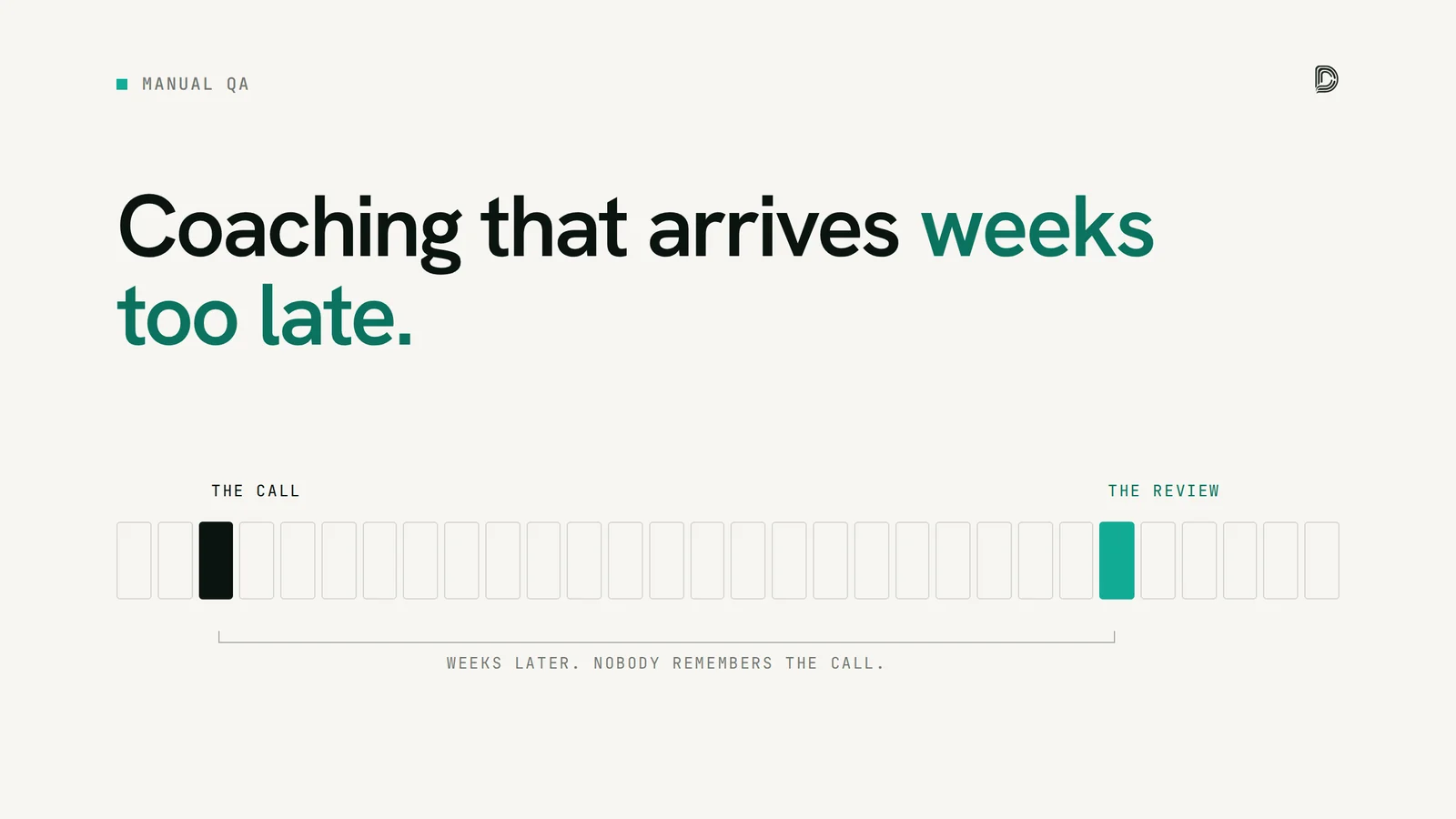
2. Coaching happens too late to matter
Manual auditing creates a delayed feedback loop:
- Calls are reviewed weeks later.
- Agents no longer remember the interaction.
- Coaching becomes generic instead of precise.
Effective performance improvement requires immediacy and specificity, not retrospective commentary.
3. Customer churn signals go undetected
Customer conversations contain early warnings:
- Repeated frustration.
- Escalation requests.
- Cancellation language.
- Competitor mentions.
Sampling misses most of these signals, so companies react to churn only after customers leave.
4. Revenue opportunities are lost in conversation data
Sales calls contain measurable indicators of success:
- Language that drives conversion.
- Questions that uncover buying intent.
- Closing techniques that work.
When only a small fraction of calls is analyzed, companies rely on intuition rather than evidence.
The hidden operational cost of manual QA
Manual auditing requires:
- Large QA teams.
- Minutes of listening for every call reviewed.
- Subjective scoring.
- Administrative documentation.
- Continuous recalibration sessions.
That makes it expensive in three ways:
- Direct labor cost.
- Opportunity cost from missed insight.
- Risk cost from unseen failures.
The third is often the most significant, and the least measured.
How AI removes the blind spot
Modern conversation intelligence platforms like Drellia evaluate 100% of calls and chats automatically, turning every conversation into structured data. Instead of sampling, AI gives you:
- Full compliance coverage against your own questionnaires.
- Alerts with the exact quote when a flagged question is missed.
- Consistent automated scoring.
- Coaching insights after every conversation, by employee and department.
- Answers to questions about your conversations in plain language.
QA moves from a monitoring task to a source of decisions.
What changes when you move beyond manual auditing
Efficiency gains
- Less time spent listening to calls to find the ones that matter.
- Faster audit turnaround.
- Automated scoring and reporting.
Risk reduction
- Earlier detection of compliance breaches.
- Exposure you can measure.
- Evidence for regulatory reviews.
Revenue improvements
- The behaviors of top performers, shared across the team.
- Conversion barriers identified.
- Coaching based on data.
The shift isn’t about replacing QA teams. It’s about giving them complete visibility.
Manual auditing measures activity. AI measures reality.
Manual QA answers: “Did we check some calls?”
AI QA answers: “What is actually happening in every conversation?”
That difference decides whether an organization runs on assumptions or evidence. Book a demo to see what your sample is missing.