The true business cost of partial call auditing
Reviewing a few calls leaves revenue leaks, compliance gaps and biased coaching hidden in the rest. The real business cost of partial call auditing.
Many organizations believe they have call auditing under control. A percentage of calls are reviewed, scores are logged and compliance boxes are checked.
But partial call auditing is one of the most expensive blind spots in modern businesses.
When only a small share of conversations is reviewed, companies expose themselves to lost revenue, compliance risk, poor customer experience and flawed decisions. The real cost isn’t just operational; it’s strategic.
What is partial call auditing?
Partial call auditing means manually reviewing a small sample of customer or sales conversations, usually picked at random or based on availability.
It is still common in:
- Sales teams.
- Contact centers.
- Financial services.
- Healthcare and other regulated industries.
The problem? Most conversations go unseen.
The hidden costs of partial call auditing
1. Revenue leakage you can’t see
Missed upsell signals, weak objection handling or pricing confusion often happen outside the small sample of audited calls.
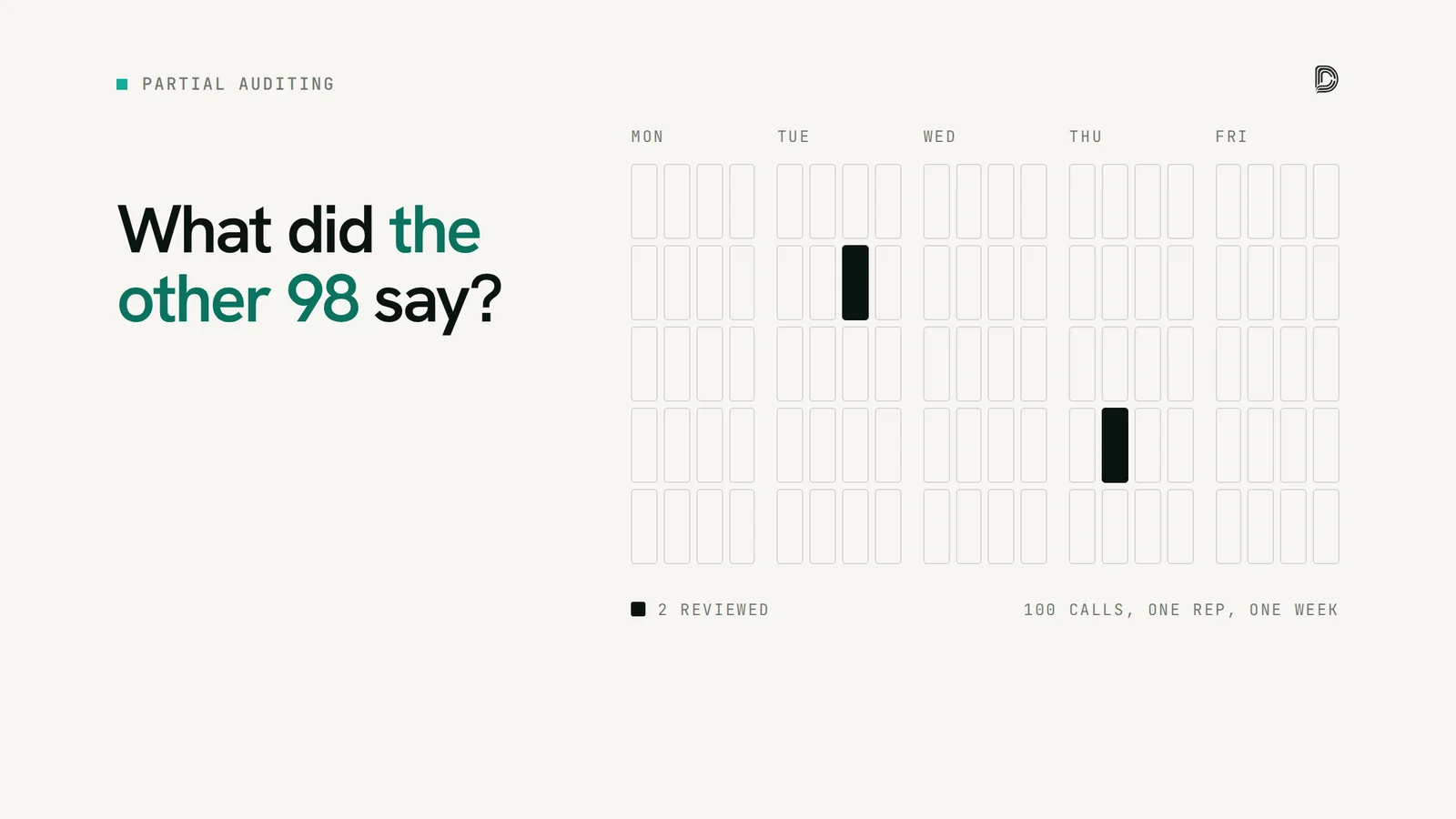
If a top-performing rep handles 100 calls a week and only 2 are reviewed:
- Coaching decisions are incomplete.
- Winning behaviors are never shared.
- Losing behaviors persist.
Across a large sales team, those missed opportunities add up to significant unrealized revenue.
2. A false sense of compliance
Partial auditing creates compliance confidence without compliance certainty. Under rules such as:
- GDPR in Europe.
- CCPA and PCI DSS in the United States.
- FCA regulations in the UK.
One missed disclosure or mishandled call can lead to fines, lawsuits or reputational damage. Partial audits don’t prevent risk; they delay discovery.
3. Inconsistent customer experience across teams
A script that works for one team may sound aggressive or unclear when another team delivers it. With partial auditing:
- Communication gaps between teams go unnoticed.
- Differences in how the offer is explained are missed.
- Customer dissatisfaction spreads silently.
That leads to lower NPS, higher churn and damaged brand trust.
4. Biased and inaccurate coaching
Managers coach based on what they hear, not what actually happens. Partial auditing causes:
- Confirmation bias.
- Over-coaching a few reps.
- Under-coaching the ones who need it most.
The result is slower ramp-up, uneven performance and frustrated teams.
5. Operational inefficiency at scale
Manual audits don’t scale. As organizations grow across markets and channels (calls and chat), partial auditing becomes:
- Time-consuming.
- Expensive.
- Impossible to standardize.
Businesses end up spending more to learn less.
Why full conversation intelligence changes the equation
Instead of sampling conversations, Drellia:
- Evaluates 100% of calls and chats against your own questionnaires, in Spanish and English.
- Flags risk and missed steps in every conversation, with alerts that quote the conversation.
- Applies your regulatory requirements as questions, the same way on every call.
- Delivers automated QA after every conversation, with dashboards by employee and department.
Teams gain complete visibility, not assumptions.
What changes when you move beyond partial audits
- Reduced compliance exposure.
- Faster onboarding and coaching.
- Consistent customer experience across teams.
- Decisions based on reality, not samples.
Final thoughts
Partial call auditing isn’t just outdated; it’s risky in a world where conversations drive revenue, compliance and customer trust.
The true cost isn’t the calls you audit. It’s the ones you don’t.
With Drellia, businesses gain full conversational visibility. Stop guessing. Start knowing.