AI call auditing: what it is, benefits and limits
AI call auditing checks every call and chat, not a small sample. What it looks like, its benefits and limits, and why a hybrid model with human QA works best.
Why call auditing is moving to AI
AI is transforming the way businesses handle call auditing. While human QA teams can only review a small sample of customer interactions, AI can evaluate every call and chat after it ends.
For customer experience (CX) leaders, contact center managers, and sales enablement teams, this changes how insights are captured and acted upon.
What AI call auditing looks like
AI auditing tools go far beyond manual reviews, using advanced speech analytics and natural language processing (NLP) to deliver insights you can act on. Key features include:
-
Speech-to-text transcription – Converting every call into accurate, searchable transcripts.
-
Questionnaire scoring – Evaluating every conversation against the questions your QA team defines, from greetings to mandatory disclosures.
-
Compliance flagging – Identifying missing disclaimers or non-compliant language.
-
Alerts with evidence – Flagging missed requirements with the exact quote from the conversation, so reviewers prioritize the right follow-ups.
With AI, auditing becomes faster and more consistent.
Benefits of AI-driven call auditing
AI auditing doesn’t just make processes more efficient; it changes what quality assurance can cover:
1. Scale
Audit 100% of customer interactions, not just a small sample.
2. Speed
Get feedback after every interaction instead of weeks later, so coaching happens while the call is still fresh.
3. Consistency
Reduce reviewer-to-reviewer variation: every call is scored against the same criteria.
4. Trend analysis
Spot recurring issues, emerging patterns, or coaching opportunities over time, by employee and department, in audit dashboards.
Challenges to watch for
Useful as AI is, it has limitations. Consider these factors when implementing AI-powered auditing:
-
Transcription accuracy – Background noise or heavy accents can reduce transcription precision.
-
Human oversight – AI understands patterns, but context still matters, and humans need to interpret nuances.
-
Privacy and ethics – Always safeguard sensitive data and comply with local regulations like GDPR or CCPA.
Best practice: go hybrid
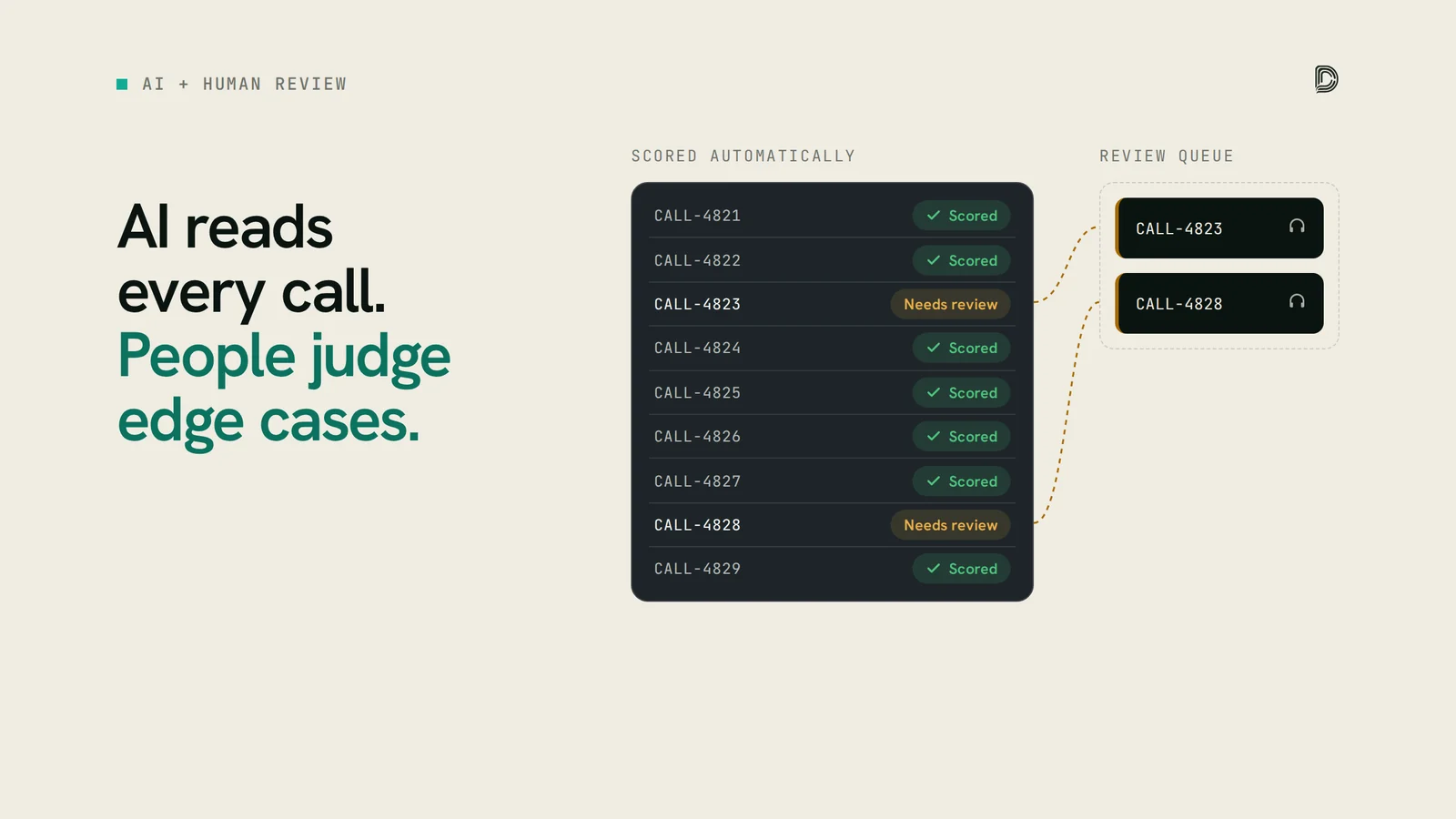
The most effective approach is a hybrid model that combines the scale of AI with the nuance of human review.
-
Use AI to analyze every conversation and flag key trends.
-
Have human QA specialists review edge cases for context and coaching opportunities.
-
Use QA feedback to refine your questionnaire questions so the criteria stay clear over time.
Conclusion: AI + humans = better auditing
AI isn’t here to replace human auditors; it’s here to support them. By combining machine precision with human expertise, organizations can build a faster and more complete auditing process.
The result? Better customer experiences, higher agent performance, and a scalable quality strategy ready for the future of CX. Book a demo to see AI call auditing on your own calls.